



Disciplined Simplicity – Building Decision-Ready Portfolio Overview
A Short Q&A with Sebastian Cadell
Written by
May 4, 2026
We caught up with Sebastian Cadell, Partner & COO at Nosco, following a recent session on pipeline and portfolio overviews. In this conversation, Sebastian shares practical insights on why most portfolio efforts fail, how organisations can break the cycle, and what it takes to build simple, decision-ready overviews that leadership can actually use.
Why do so many organisations struggle to build a working portfolio overview?
Most organisations don’t struggle because they lack frameworks. There are plenty of models out there. The challenge is making them work in practice.
What we typically see is a lack of alignment on what to track. Different teams create their own views, reporting gets duplicated, and complexity increases over time. The natural reaction is to add more data, more attributes, more detail.
Before long, the overview becomes too heavy to maintain and too difficult to trust.
What is the typical pattern when portfolio efforts break down?
There is a clear pattern. Leadership looks at the portfolio and feels it doesn’t provide enough insight to make decisions. So they ask for more information. The portfolio manager adds more attributes, which increases the burden on project owners. Updates become a chore, and data quality drops.
As trust decreases, leadership asks for even more detail. This creates a vicious cycle where the effort increases while the value decreases.
What actually works when building a portfolio overview?
What works is disciplined simplicity.
Instead of trying to capture everything, organisations need to agree on a small set of dimensions that truly matter. Typically, this includes why the initiative exists, how ambitious it is, its potential impact, the expected time horizon, the level of certainty, and whether it is progressing.
When these dimensions are clear and consistently applied, it becomes possible to compare initiatives, prioritise effectively, and maintain the overview over time.
How should organisations think about early-stage data and uncertainty?
Early-stage innovation is inherently uncertain, and this needs to be reflected in how data is handled. A common mistake is trying to calculate detailed financial metrics too early. This often leads to false precision.
Instead, it is more useful to work with ranges or categories that allow initiatives to be compared without overestimating accuracy. Being approximately right creates better decision-making than being precisely wrong.
Where do tools typically fall short?
Tools often fail in two key areas.
First, data capture. If updating information is not simple and integrated into the way teams already work, it will not happen consistently.
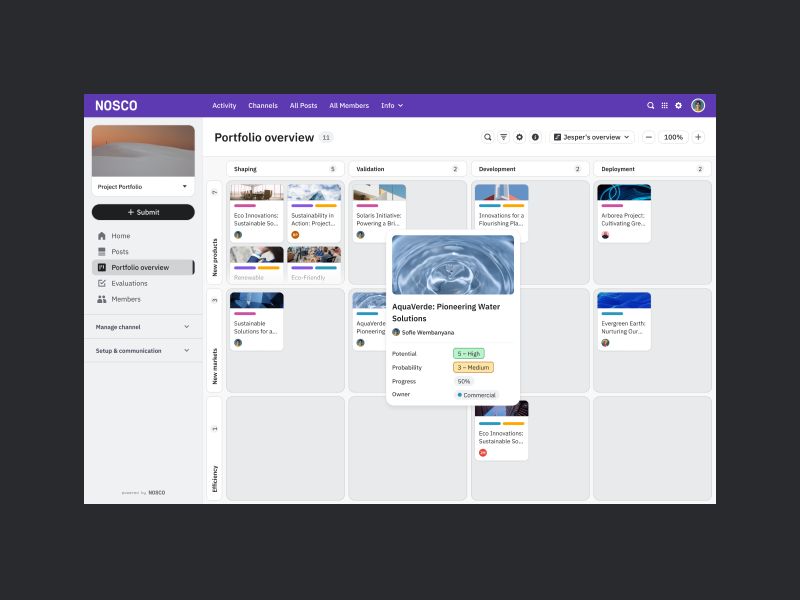
Second, visualisation. Many organisations rely on manual PowerPoint updates or reporting tools that are not designed for the type of visualisations that are needed. This leads to static views that quickly become outdated.
What is needed is a setup where data is captured once, close to the source, and can be visualised in multiple ways depending on the audience and decision context.
How does this connect to the increasing focus on AI?
There is a direct connection. AI depends on structured and reliable data. If portfolio data is fragmented or locked in slides, it cannot be meaningfully used for decision support.
When organisations establish a consistent and continuously updated portfolio structure, they create a foundation that can be leveraged by AI tools. Without that foundation, the value of AI remains limited.
How would you recommend organisations get started, or restart, their portfolio efforts?
Start smaller than you think. Many organisations fail because they try to design a complete solution from the beginning. Too many stakeholders, too many attributes, and too many use cases create unnecessary complexity.
Define a small set of dimensions, ensure the data can be updated easily, and start using the overview in real decision-making settings. From there, iterate based on what actually proves useful.
This is also where the Nosco platform plays an important role. It allows organisations to start with a simple setup and gradually expand as they learn what works. The platform is designed to adapt and scale with the organisation, supporting both early-stage simplicity and more advanced portfolio needs over time.

Partner

Sebastian Cadell has more than 25 years of experience helping companies strengthen their innovation efforts. He works at the intersection of strategy, innovation, and organisational development - guiding teams in building their innovation operating models, and their pipelines of innovation and improvement projects. He also leads the strategic development of the Nosco Platform.
MORE ARTICLES
https://nos.co/building-decision-ready-portfolio-overview/
https://nos.co/building-your-innovation-pipeline-portfolio-overview/
https://nos.co/the-hidden-flaw-in-project-portfolio-management-tools/

https://nos.co/getting-your-organisation-licensed-to-innovate/

https://nos.co/how-to-run-successful-ai-idea-campaigns/

https://nos.co/aligning-promise-and-practice/