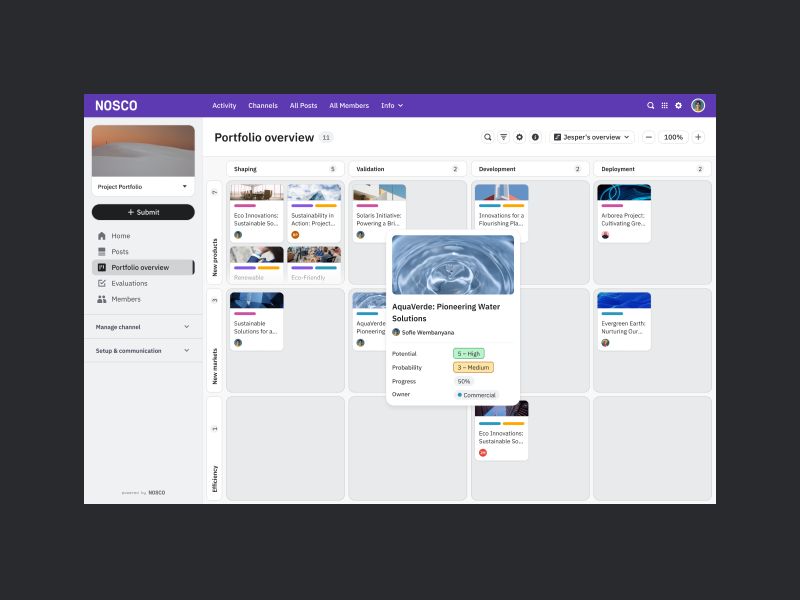


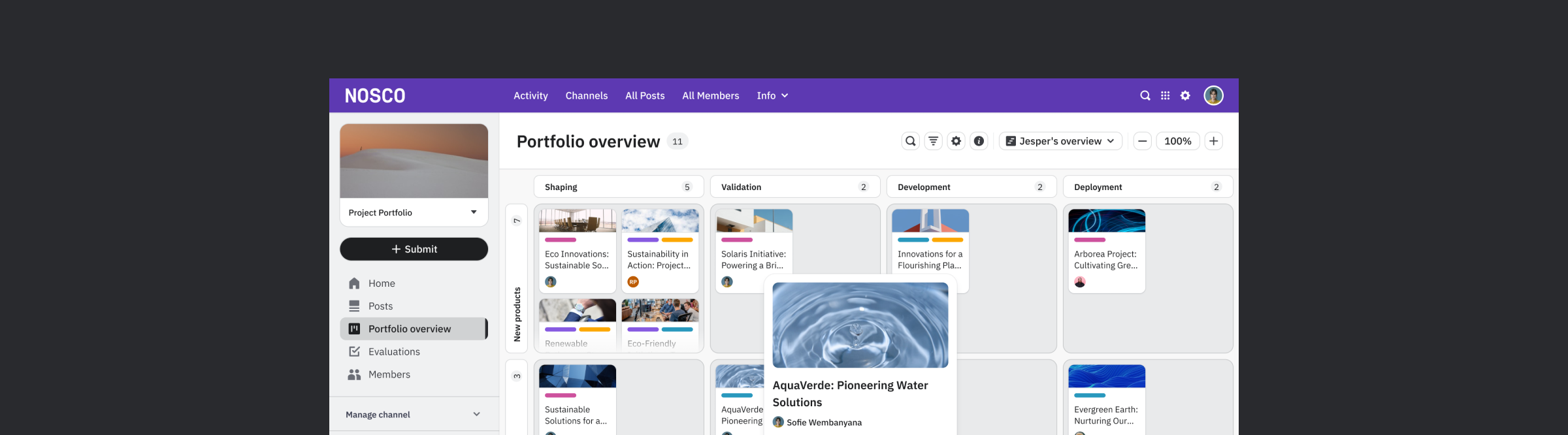
Most innovation leaders can sketch an innovation pipeline or portfolio model on a whiteboard in under five minutes. McKinsey’s Three Horizons. The Innovation Ambition Matrix (maybe better known as the Core–Adjacent–Transformational framework). Strategyzer’s Explore-Exploit portfolio map.
The frameworks are well known. The terminology is shared. And yet, in practice, most organizations still struggle with a basic question: “Do we actually have one shared, transparent view of our innovation pipeline and portfolio?”
For many, the honest answer is “no”.
The real challenge isn’t the framework – it’s the information
Across large organisations, innovation portfolios often exist as a patchwork: A PowerPoint snapshot for the board, a handful of Excel sheets owned by different units, a project list somewhere in the PMO tool, or a few critical initiatives tracked off-system in people’s heads.
At the core of the issue is a failure to agree on what information truly matters, and how to track it consistently across the lifecycle.
In our work with innovation leaders across industries, we see the same pattern repeatedly:
- Too many attributes being tracked
- Lack of a shared set of key portfolio attributes
- Attributes that change over the life cycle
- Financial metrics applied too early
- Multiple Excel sheets and duplicated reporting efforts
The result? Portfolio efforts start with ambition, lose momentum, and stall – or survive only as ad hoc reporting exercises. And as a consequence don’t support consistent decision-making.
Six dimensions that consistently make the difference
Teams that manage to establish a single, shared portfolio view tend to converge on a surprisingly small set of core dimensions. Not dozens. Not hundreds. But six.
1. Domain / Driver: Why does this initiative exist?
Every innovation initiative should clearly answer: What domain does the opportunity belong to? Which strategic driver does the initiative support? Or which strategic priority does the initiative serve?
At a general driver level, this might look like:
- Revenue growth
- Cost reduction or operational efficiency
- Sustainability or compliance
- Digitalisation of the business
- Exploration of entirely new domain.
Without this anchoring, portfolios devolve into collections of projects rather than a strategic instrument to drive innovation in the areas that matter most to the business. The aim is not to track all of these attributes, but to choose the one that provides the right level of specificity for explaining why an initiative matters to the business.
2. Ambition level: How new is this really?
Classic models like the Three Horizons or Core–Adjacent–Transformational can be powerful because they force a conversation about the level of ambition.
Below the surface, this dimension can be broken down into technology or solution newness and market or customer newness. But typically we find that it is sufficient to track opportunities as core, adjacent, or transformational.
This dimension helps leaders balance incremental improvements versus more transformational bets. And critically it can help avoid comparing fundamentally different initiatives on the same terms.
3. Business potential: If it works, will it move the needle?
One of the most common portfolio traps is financial false precision. Early-stage initiatives are often forced into total addressable market estimations, detailed business cases, Net Present Value (NPV) calculations long before the problem-solution fit has even been validated.
For portfolio-level overviews, what works far better is focusing on business potential and gauging this in bands or categories, for example on a scale of “1 – EUR 0-50k” to “5 – EUR 50m+”. As the innovation opportunity is shaped, validated, developed, and launched, a set of supporting measures can expanded, e.g. from total addressable market, over peak revenue potential, to NPV. And the level of certainty about the business potential will increase.
Tracking business potential in bands or categories allows for a shared view across all stages of the innovation pipeline. And the broad categories can also be developed to ensure alignment and comparability between top-line growth opportunities and cost-savings opportunities.
4. Time horizon: When could value realistically materialise?
Time is the most underappreciated portfolio dimension. But with leadership always under pressure to deliver results, this may be the second most important attribute after business potential.
Portfolios typically distinguish between:
- Time to market
- Time to value
- Time to break even
- Time to full impact
With time to market or time to value often being the attributes that can best be tracked across the pipeline.
5. Degree of certainty: How sure are we – really?
High-performing portfolios explicitly track degree of certainty, whether expressed as:
- Degree of certainty
- Probability of success
- Innovation risk
The goal is not to eliminate uncertainty – that would kill innovation – but to make it visible so that risk exposure is intentional, not accidental.
In later stages of the innovation life cycle, the degree of certainty can be detailed in terms of degree of certainty about desirability / market readiness level, feasibility / technology readiness level, viability, and sustainability.
6. Progress: Is this actually moving forward?
Finally, progress must be more than stage gates. Effective portfolios combine:
- Stage (discovery, shaping, validation, development, launch, …)
- Progress within stage
- Overall project health
This shifts the conversation from “Do we have the right projects in the portfolio?” to “Are the projects in the portfolio in good shape and progressing?”
One more thing: choose attributes that survive the lifecycle
A subtle but critical insight: portfolio attributes should remain valid from early exploration to launch and scale.
That is why:
- Business potential works better than NPV
- Expected time to value works better than time to break even
- Degree of certainty works better than technology readiness level
When attributes can’t be tracked through the lifecycle, the portfolio view fragments – and trust erodes.
Tools matter more than most leaders think
Even with the right dimensions, many organisations still struggle. Why? Because portfolios only work if:
- Project owners can update information easily
- Data is captured once, close to the source
- Visualisations don’t have to be made by hand in PowerPoint
- Overviews work at board, leadership, and execution level
Static slides don’t scale. Spreadsheets don’t invite ownership. Generic project tools don’t reflect innovation reality. This is where purpose-built innovation portfolio platforms enter the picture.
The Nosco Platform enables organisations to:
- Track the right attributes consistently across all initiatives
- Give project owners simple, intuitive ways to update progress
- Maintain one shared, real-time view of the pipeline and portfolio
- Visualise business potential, progress, degree of certainty, and project health by strategic priority without manual reporting
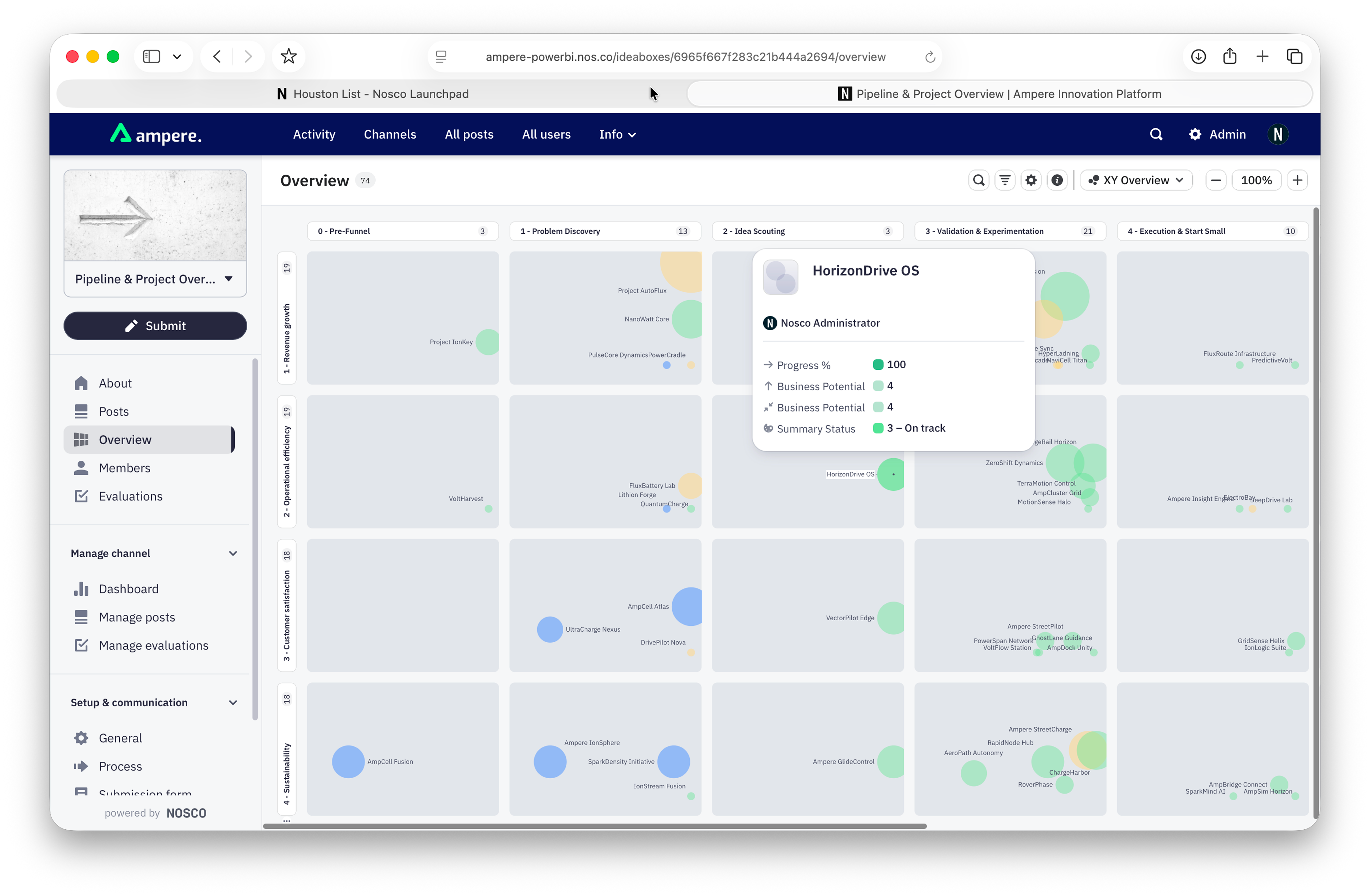
Innovation portfolios don’t fail because leaders don’t know the models. They fail because organisations don’t operationalise the few dimensions that actually drive clarity and decision-making. When those six dimensions are finally in place, your pipeline and portfolio overview can become a strategic advantage.