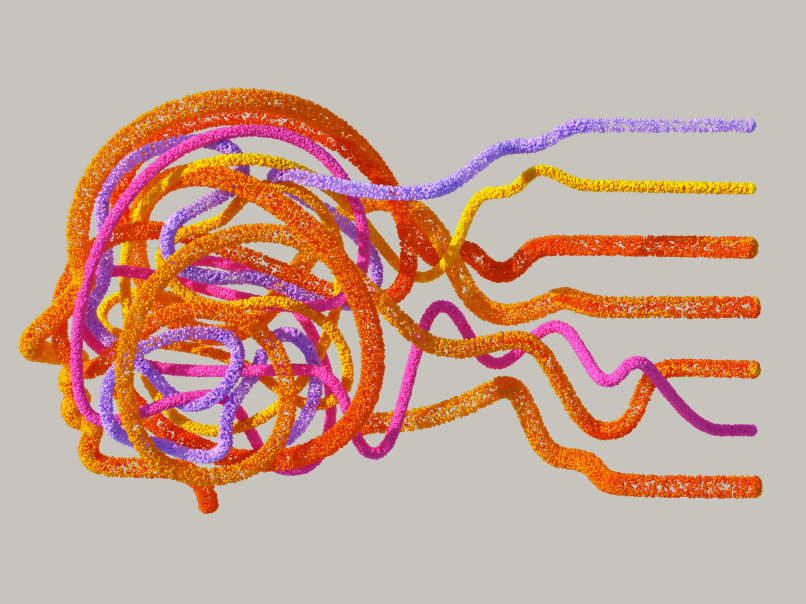


Behind Many Failed Innovation Efforts Sits a Beautiful Dashboard
Most corporate innovation failures don’t happen because leaders don’t care. They happen when dashboards replace leadership.
Written by
May 18, 2026
A CEO once reflected on a string of failed innovation initiatives with a simple line: “For every one of our failures, we had spreadsheets that looked awesome.” What makes the quote powerful isn’t the criticism of numbers – it’s the recognition of their limits. Spreadsheets didn’t cause the failure. They just made it harder to see.
In today’s organizations, spreadsheets have been replaced by dashboards. But the dynamic is remarkably similar. Most corporate innovation failures don’t happen because leaders don’t care. They happen because leaders care from a distance.
If you’ve worked with innovation portfolios for any length of time, you’ve likely seen it:
a beautifully designed dashboard, live KPIs, clean traffic lights, quarterly updates that look reassuringly “under control”. And then – suddenly – nothing works.
The most promising initiative stalls. A core assumption turns out to be wrong. Three years and millions later, the organization quietly moves on.
The dashboard didn’t lie. It just didn’t tell the truth.
The Seduction of the Aggregate
Dashboards are irresistible to leaders for good reason. They provide:
- Comparability
- Pattern recognition
- A sense of control
- Distance from operational noise
In business as usual, this works remarkably well. Financial performance, operational efficiency, supply chain metrics all benefit from aggregation.
But innovation is not business as usual. Innovation exists precisely where:
- Outcomes are uncertain
- Progress is non-linear
- Teams work with incomplete information
When you aggregate uncertainty, you don’t reduce risk – you erase the signal.
Innovation Can’t Be Led in the Aggregate
An innovation portfolio is not like other transformation or improvement programs. Most transformation and improvement portfolios are characterised by a large number of projects with a moderate degree of variance – and can be managed in the aggregate based on the law of large numbers. Most innovation portfolios cannot because the portfolios are often smaller, and the individual projects display much higher degrees of variance.
Each project has:
- Different uncertainties
- Different learning curves
- Different leadership needs
Trying to “manage” innovation through portfolio-level KPIs – like # of initiatives, percentage core/adjacent/transformational split, and risk-adjusted NPV of pipeline – is like trying to manage people by only tracking headcount, performance distribution, and revenue per employee.
Technically accurate. Practically useless.
Innovation Needs Proximity, Not Just Oversight
Successful innovation leaders are uncomfortably close to the work. They:
- Know the teams
- Understand the hypotheses
- Can sense when confidence is warranted – and when it’s performative
- Recognize when “green” actually means “unexamined”
This doesn’t mean micromanagement. It means involvement without interference.
Just like people management you don’t manage talent by dashboard alone. You manage it through conversation, observation, and judgment.
Innovation management is far closer to leadership coaching than operational reporting.
The Role of Qualitative Insight
If dashboards struggle with innovation, what’s missing? Narrative.
The most important innovation signals are often qualitative:
- How confident is the team in their core assumptions?
- What surprised them this month?
- What’s blocking them – and why?
- What are they no longer sure about?
These insights don’t compress well into KPIs. Yet they are exactly what senior leaders need to decide:
- Where to lean in
- Where to challenge
- Where to give air cover
- Where to stop pretending
Innovation progress happens through learning, not ticking boxes. If learning isn’t visible, progress isn’t real.
Cadence Over Reporting
One of the most reliable predictors of innovation success isn’t a metric. It’s meeting cadence.
Specifically:
- Regular, structured conversations between project teams and their sponsors
- Focused on learning, not justification
- Repeated often enough to create pattern recognition
These aren’t status meetings. They’re sense-making sessions:
- What have we done?
- What have we learned?
- What has changed – and why?
Over time, leaders develop a feel for the project. That “feel” is often what triggers:
- Timely intervention
- Course correction
- Or a brave, early stop
And that “feel” can be translated into project health indicators like:
- Overall health – What is the overall health of the project?
- Scope – Are we clear on the assumptions to be tested? Is the scope realistic? And is it still relevant to the business?
- Resources – Does the project have the needed resources?
- Traction – Is the project making traction in terms of testing assumptions?
These indicators aren’t KPIs in the traditional sense – they are prompts for gauging the progress of the project. And they are closer to how experienced leaders assess people: contextually, comparatively, and over time.
Staying Close to What Matters Most
No leadership team can be close to everything. Which makes selectivity critical. A mature innovation operating model allows leaders to:
- Zoom in on a few critical initiatives
- Maintain light-touch visibility on the rest
- Dynamically shift attention as risk changes
The question isn’t: “How do all projects perform?” It is: “Which projects need leadership attention right now?”
That answer rarely comes from summations or averages. It comes from transparency of variance, tension, and uncertainty.
Dashboards Are Not the Enemy
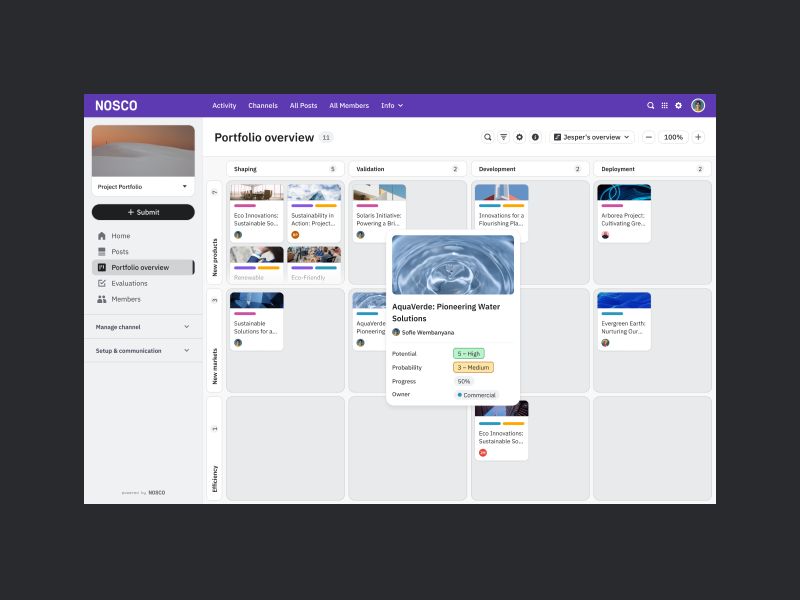
Dashboards aren’t the problem. Substituting dashboards for leadership is. Used well, overviews should:
- Preserve granularity, not erase it
- Support questions, not provide comfort
- Trigger conversations, not replace them
The strongest innovation dashboards don’t try to simplify reality. They invite leaders back into it.
The Real Work of Innovation Leadership
Innovation fails not because leaders lack insight – but because they rely on representations of reality that were designed for stability. Innovation demands something harder:
- Presence
- Curiosity
- Judgment
- And the humility to admit that progress can’t always be summarized
Behind many failed innovation efforts sits a beautiful dashboard – perfectly aligned, reassuringly green, and quietly disconnected from the truth.
The leaders who succeed choose something messier. They choose closeness over comfort.

Partner

Sebastian Cadell has more than 25 years of experience helping companies strengthen their innovation efforts. He works at the intersection of strategy, innovation, and organisational development - guiding teams in building their innovation operating models, and their pipelines of innovation and improvement projects. He also leads the strategic development of the Nosco Platform.
MORE ARTICLES
https://nos.co/why-dashboards-hide-innovation-failures/

https://nos.co/building-decision-ready-portfolio-overview/
https://nos.co/building-your-innovation-pipeline-portfolio-overview/
https://nos.co/the-hidden-flaw-in-project-portfolio-management-tools/

https://nos.co/getting-your-organisation-licensed-to-innovate/
https://nos.co/how-to-run-successful-ai-idea-campaigns/